
The Five-Layer Model
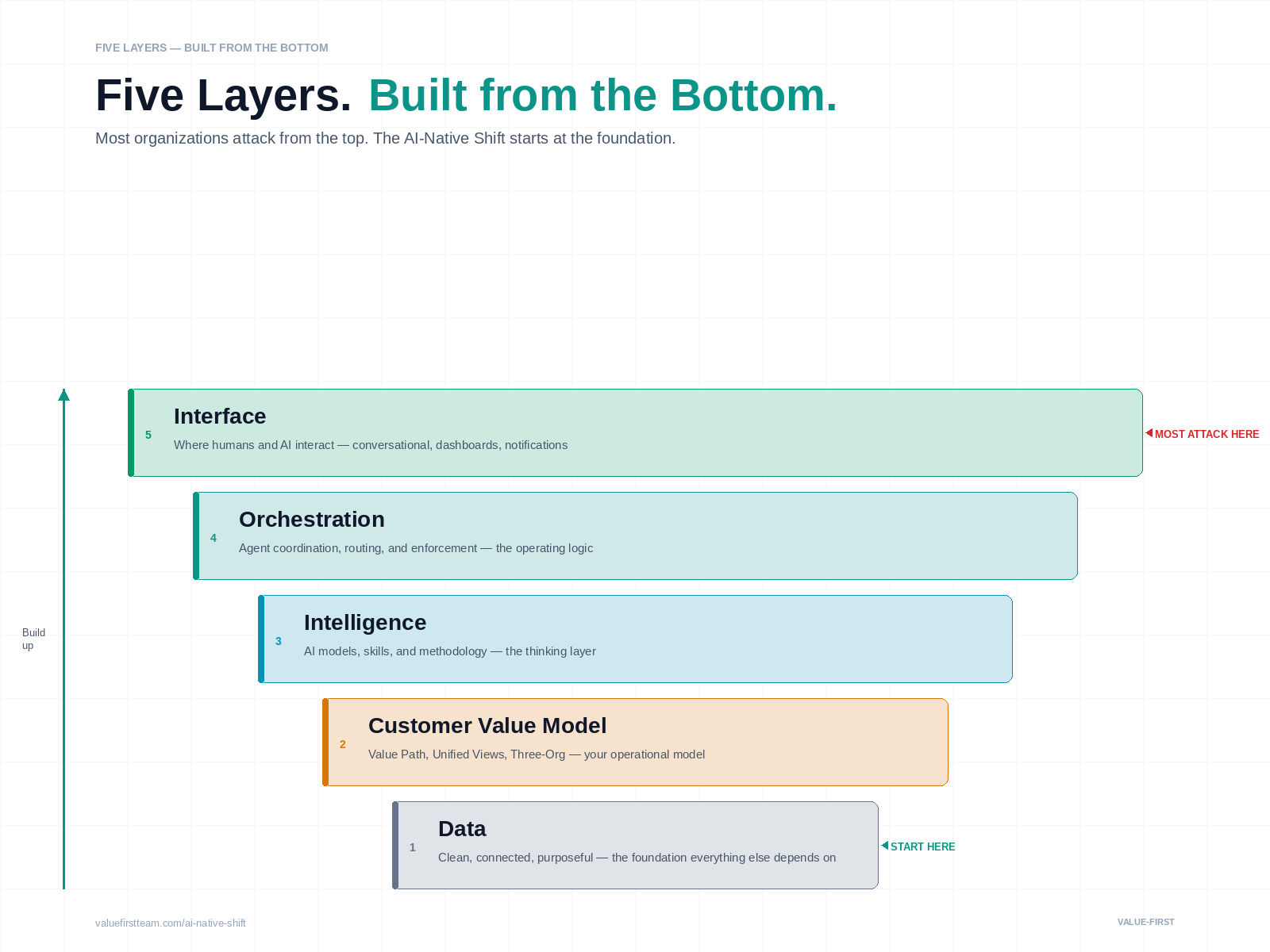
The Five-Layer Model describes any organization as five layers, stacked bottom-up — from the raw material of the business to the surfaces where humans meet it.
Industrial Age ↔ AI-Native The business world you operate inTrapped ↔ Transformed Who you are / who you become in that world
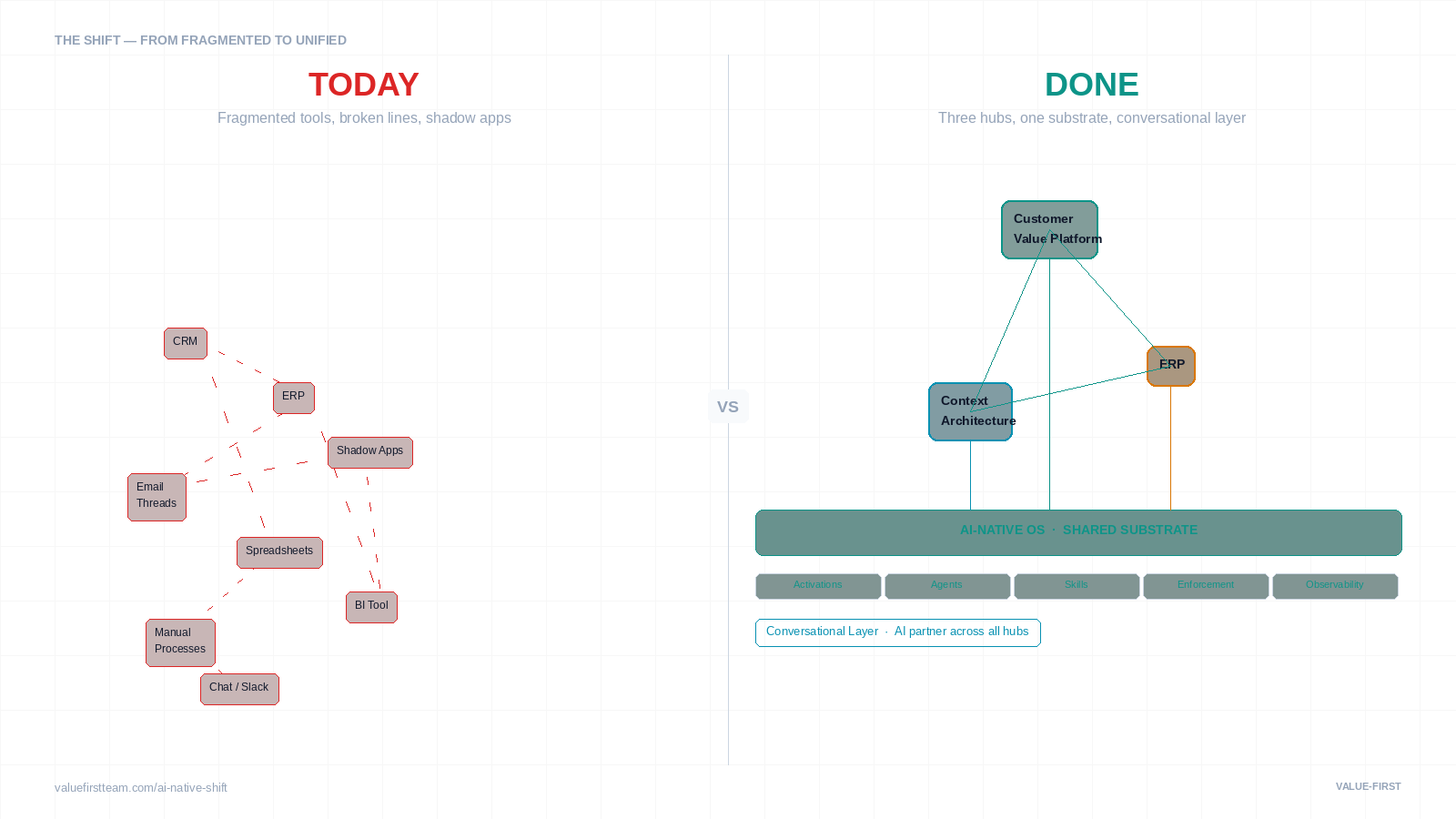
The Shift Tribal Knowledge → Human Domain ExpertiseFragmented context → Composed context
The five layers are the five layers of an AI-Native Operating System — the operating system is what the five layers compose, not one of them.
The same five layers are present in every organization. What changes between the Industrial Age and the AI-Native world is not which layers exist, but whether they compose.
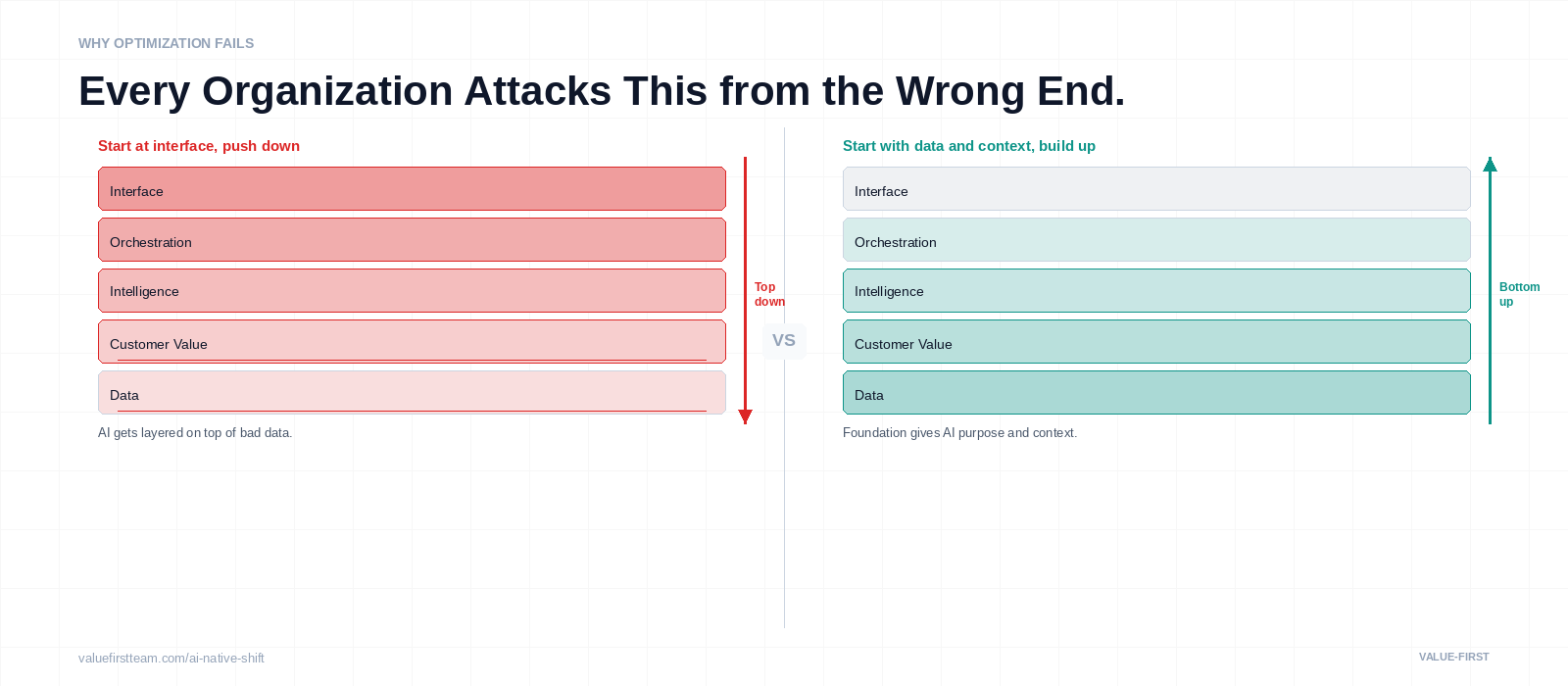
The stack reads bottom-up: each layer earns the weight of the one above it.
- Status
- canonical
- Cite
- valuecreationprotocol.com/five-layers
- Source
- Generated from the canonical reference and checked against it on every build
Data, Identity, Context
Sources of truth, memory
What it is
The foundational layer — the org's Data, Identity, and Context, each read at the full breadth of the layer's own name. The layer NAME governs; the record-scoped wording below is illustrative of one instance, not the limit of the scope.
Customer Value Model
What the data means
What it is
The explicit model of what creates value for your customers, for whom, and why. This is the layer that answers "why does our work matter, and to whom" in operational terms — not as a slogan, but as a structure the rest of the business runs from. In an AI-Native organization, this layer is occupied by the Unified Customer View and the Unified Revenue View.
Intelligence
Who has context + capability
What it is
The layer that holds the judgment of the business: the pattern recognition, the situational reasoning, the synthesis across context that turns information into a decision. Your Humans and Your Agents hold this layer: Human Domain Expertise, documented and shared, on the human side, and your agents on the technological side, both present in an AI-Native organization.
Orchestration
How the work moves
What it is
The coordination layer: the substrate that lets the layers below interoperate, the agents at Layer 3 work as a team, and the apps at Layer 5 inherit a trustworthy foundation instead of fragmenting. Automation and Governance hold it. Most organizations don't yet have this layer, the one that determines whether everything above and below runs as an operating model or a pile of integrations.
Interface
Every surface where humans meet you
What it is
Every surface where humans meet you. Layer 5 is not only internal work tools. It is every surface where a human meets the organization — internal work surfaces (email, chat, project tools, the workspace) and outbound / audience / content surfaces (public sites, social, newsletters, how you show up to an audience). (Broadened by Chris ruling, 2026-07-13.)
How leaders use it
Diagnostic
Map your organization against the five layers using the Five-Layer Shift as the reference. Which layers are strong? Which are implicit? Which are held together by tribal knowledge? The diagnostic is the entry point to the program's Mindset work.
Architectural
"Should we add this dashboard?" is a Layer 5 question — and the answer is almost always to fix Layer 4 first. "Should we add another integration?" is a Layer 1 question — and the answer is usually to make the existing data coherent before adding more.
Operational
When something isn't working, the model gives you the question to ask: which layer is producing the problem? Most "AI isn't working" complaints are Layer 1 or Layer 2 problems. Most "we have too many tools" complaints are Layer 4 problems. Most "the team is burning out" complaints are key-person-as-bottleneck — Layer 4 again.
The figure set
Protocol home
VCP is originated and canonically implemented by Value-First Team. Anyone may read, cite, and operate the protocol independently of firm engagement.