
A MANIFESTO · MAY 2026 · VALUECREATIONPROTOCOL.COM
A Positioning Paper
Two protocols have emerged to solve the layers below value creation: MCP for capability, HCP for human context. Neither one creates value on its own. Neither one was ever supposed to. This is the layer that does.
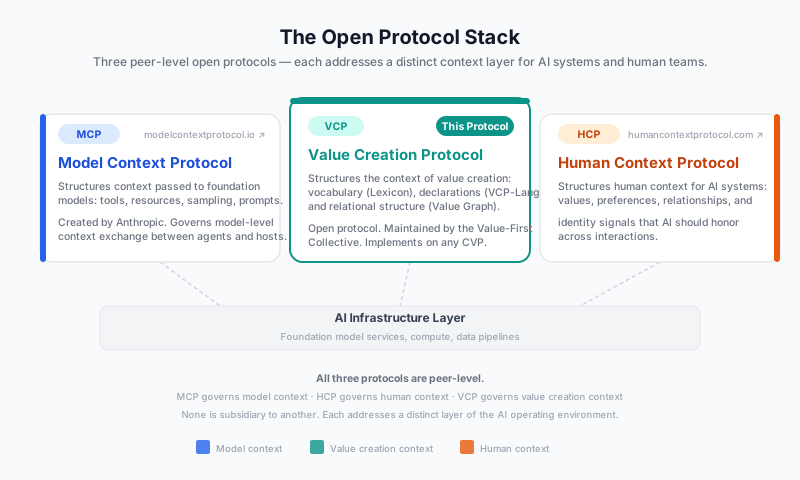
The protocol stack is not a hierarchy. It is a set of peers.
A Positioning Paper
Purpose: Introduce the Value Creation Protocol (VCP) as the business-application layer that sits atop the Model Context Protocol (MCP) and the Human Context Protocol (HCP). Establish the Value-First Team's position in a three-layer stack and invite the market to build on it.
Audience: Business leaders, AI practitioners, HubSpot partners, and anyone asking the question: now that AI can connect to everything and carry human context, how do we actually create value with it?
Usage: Publish as a standalone article on valuefirstteam.com. Share on LinkedIn. Reference in keynotes, client conversations, and program materials. Adapt sections for slide decks and email introductions.
The Point Was Never the Model
Every conversation about AI right now is a conversation about capability. How fast. How smart. How autonomous. How many tokens. How many agents.
None of that is the point.
The point is what capability makes possible for the humans on both sides of it — the customers being served, the teams doing the serving, the organizations holding the whole thing together. Capability without a way to direct it toward value is just velocity in a random direction.
Two protocols have emerged to solve the two pieces of the problem that exist below value creation. Neither one creates value on its own. And neither one was ever supposed to.
The Two Protocols That Got Us This Far
MCP — Model Context Protocol
Released by Anthropic in November 2024, now stewarded under the Linux Foundation, MCP standardizes how AI models connect to the systems where work actually happens. It solves the N-by-M integration problem. Every model can talk to every tool through a shared grammar.
MCP answers: how does capability reach the work?
HCP — Human Context Protocol
Proposed in early 2025 by researchers at MIT, Oxford, Microsoft Research, and the Stanford Digital Economy Lab — and now being operationalized through the Loyal Agents initiative with Consumer Reports — HCP standardizes how a person's values, context, and trust parameters travel with them across AI systems. A preference layer the individual owns. A human counterpart to MCP's system layer.
HCP answers: how does human meaning reach the model?
What's Still Missing
MCP makes the tools reachable. HCP makes the person legible. Neither one tells an organization how to turn those two things into value for its customers, its team, its partners, or itself.
That translation — from capability and context into realized value for all stakeholders — is not a protocol problem. It's a methodology problem. And until it's named, it defaults to whatever industrial-age patterns the training data has pre-loaded.
This is where the Value Creation Protocol begins.
Introducing the Value Creation Protocol
VCP is the methodology layer that translates MCP capability and HCP context into value for every stakeholder an organization serves.
VCP is not a competing protocol. It does not duplicate the work of MCP or HCP. It sits on top of both and answers the question neither of them is designed to answer:
Given that AI can connect to anything and carry human context into any model, how does a business use that combination to create genuine, compounding value for the people it serves, the people who serve, and the stakeholders who make the work possible?
MCP is the wiring. HCP is the signal. VCP is what the wiring and the signal are for.
The Three-Layer Equation
MCP   (Capability)      → How AI reaches the work
HCP   (Human Context)   → How human meaning reaches the model
VCP   (Value Creation)  → How organizations translate both into realized value
MCP alone gives you an agent that can do things it shouldn't do.
HCP alone gives you a portable profile with nowhere to land.
MCP + HCP without VCP gives you a capable, personalized AI that still defaults to transactional patterns because nothing has told it what value looks like for this organization and these relationships.
MCP + HCP + VCP gives you an operating model where capability, context, and intent compound — for the customer, for the team, for the business, and for the broader ecosystem.
What VCP Encodes
VCP is built on frameworks that have been operating inside the Value-First Team and its client work for years. They're not new. What's new is naming them as the applied layer of a protocol stack that the industry is already converging on.
The Value Path
Eight stages of natural progression — Audience, Researcher, Hand-Raiser, Buyer, Value Creator, Adopter, Advocate, Champion. Not a pipeline. A readable map of how humans actually move toward and through value. VCP encodes this as the primary signal an organization should read.
The Four Unified Views
Customer, Revenue, Business Context, Team Enablement. The semantic layer that turns data into something an AI can reason about with purpose. VCP encodes these as the canonical view schema any organization can adapt to its own reality.
The Five Core Beliefs
Natural Value Flow over Artificial Control. Empowerment over Learned Helplessness. Wholeness over Fragmentation. AI-Human Partnership over Replacement. Emergence over Predictability. VCP encodes these as the design constraints that prevent drift back into industrial-age defaults.
The TEACH Values
Transparent ↔ Trust. Empathetic ↔ Empowered. Agile ↔ Adaptable. Confidence ↔ Conviction. Humble ↔ Hungry. Five tensions, held productively. VCP encodes these as the operating posture of anyone — human or AI — working inside the stack.
The Three-Org Model
Customer Org (human-led). Operations Org (AI-led). Finance Org (shared). VCP encodes this as the organizational architecture that makes AI-native operations coherent rather than chaotic.
These are not decorative. They are the protocol's working parts.
Where VCP Already Lives
The pattern has been running for some time without its name.
- Inside the Value-First Team's own operations — where AI handles coordination, documentation, and follow-through while humans hold relationships, judgment, and vision. The Three-Org Model in practice, not theory.
- Inside the enforcement skill layer — the executable rules that catch training-data defaults (funnels, pipelines, quick wins, phases) and correct them before they become implementation. VCP gives this layer its protocol-level name.
- Inside the AI-Native Shift program — a four-rung progression from Office Hours through the Value-First OS deployment. Each rung is VCP being adopted at a different depth.
- Inside client work — where VCP-encoded frameworks have replaced bolt-on sales-and-marketing machinery with relationship-first architectures that serve every stakeholder the organization touches.
The job now is to make VCP visible as the thing that has been carrying the weight all along.
The Great Simplification
For two decades, organizations have been stacking software to compensate for the absence of a coherent operating model. Martech stacks. Revenue-operations middleware. Integration platforms for the integration platforms. Layers of duct tape hiding the fact that no single system could carry both capability and meaning at the same time.
That middle layer is collapsing. We call the collapse the SaaSpocalypse.
What replaces the collapsed middle is simpler than what existed before: capability informed by context, directed by methodology, oriented toward value for everyone involved.
- MCP carries the capability.
- HCP carries the human context.
- VCP carries the methodology that turns both into outcomes people can actually feel.
No layer does the others' work. Each layer is irreducible. Together they make most of what currently lives in the middle unnecessary.
That is the simplification.
An Open Framework
VCP is not a Value-First Team product. It is a methodology the Value-First Team has been building, teaching, and refining — and the moment has arrived to release it as a named, shareable, extensible framework.
Anyone can implement VCP. Anyone can build on it. Anyone can teach it. The Value-First Team has a specific implementation tuned for HubSpot-centered organizations and AI-native operations, but the protocol itself is not ours to gate.
What we ask is the same thing we ask of everyone who encounters Value-First work:
- Honor the humans on every side of the work.
- Let capability serve meaning, not the other way around.
- Refuse to collapse transformation back into optimization.
- Build systems that compound trust instead of spending it.
If you are working on the same problem under a different name, find us. If you are building business infrastructure for a post-SaaSpocalypse world, use this. If you are teaching the next generation of operators what AI-native actually means, name the layer they're standing on.
Value was always the point. The protocols are finally catching up.
MCP gives AI capability. HCP gives AI human context. VCP gives organizations a way to turn both into value for everyone they serve.
Build on it.
Chris Carolan is the founder of the Value-First Team and the architect of an AI-native methodology built on the principle that relationships are not transactions, configuration is not customization, and value is not an output — it is the organizing logic of the whole system.
The Value Creation Protocol is an open framework. The Value-First Team provides the canonical implementation for HubSpot-centered organizations and offers a progression from free Office Hours through full operating-system deployment for teams ready to make the shift.
valuefirstteam.com
Protocol home
VCP is originated and canonically implemented by Value-First Team. The manifestos are published openly; anyone may read, cite, and operate the protocol independently of firm engagement.